The neighbourhood
Sé do Porto: the old centre
A short guide to the Sé area where Casa da Guitarra stands: the cathedral, the historic centre's UNESCO listing, São Bento station and the Ribeira.
Reserve a place for the concert ↗Quick answer
Casa da Guitarra stands in the Sé area of Porto's historic centre, next to the cathedral. The centre was inscribed by UNESCO in 1996 with the Luís I Bridge and the Serra do Pilar monastery. Nearby are the cathedral, São Bento station with its azulejo panels, and the Ribeira on the Douro.
The cathedral
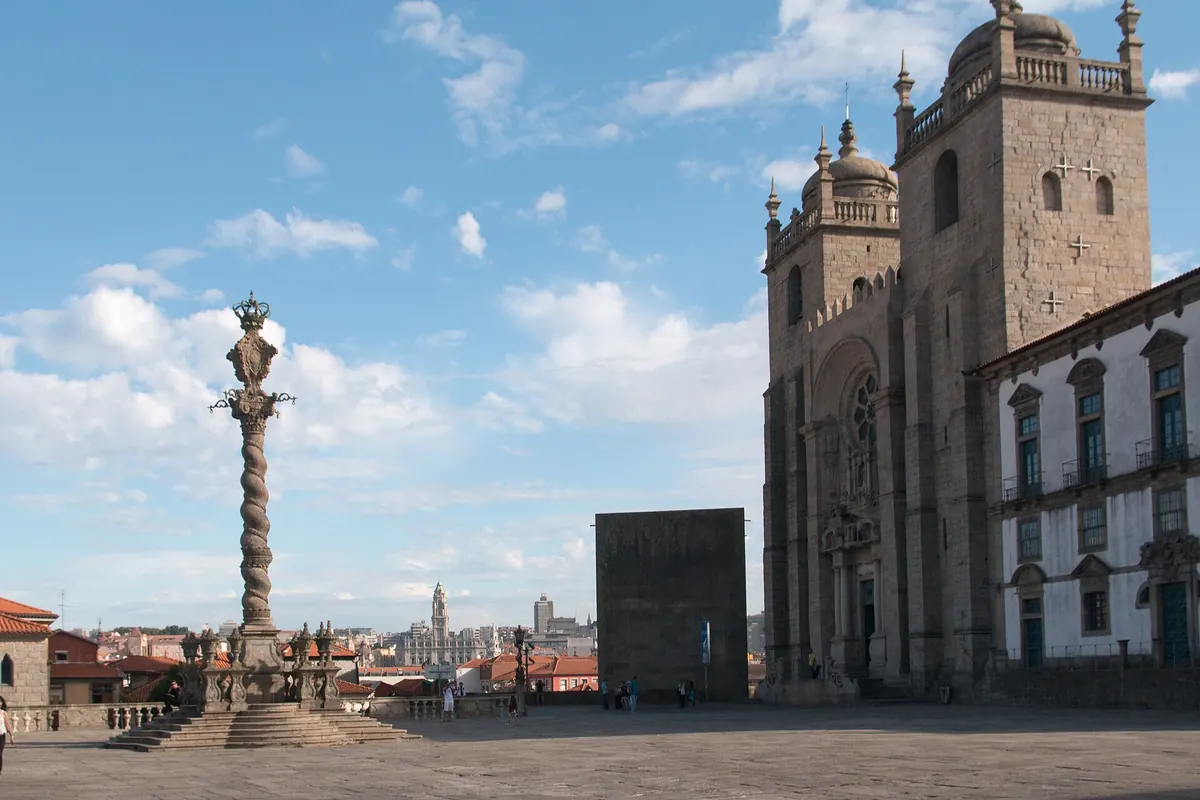
Porto Cathedral, the Sé, replaced a chapel or hermitage founded in 1108 by Henry of Burgundy and his wife. Construction of the present building began in the second half of the twelfth century and continued into the sixteenth. It has a barrel-vaulted nave and a Romanesque rose window, a Gothic funerary chapel from around 1333 and a Gothic cloister. The Baroque additions include a loggia on the side facade by Nicolau Nasoni in 1736, and a new main portal in 1772. A Baroque altarpiece was made between 1727 and 1729, and Nasoni also painted new wall decorations in the apse.
The cloister azulejos
Between 1729 and 1731 Valentim de Almeida made Baroque azulejo panels for the Gothic cloister, showing scenes from the Song of Songs. Azulejos are the glazed and painted tiles of Portugal, and the cloister panels are one of the Baroque examples in the cathedral, set beside the older Gothic stonework. São Bento station carries a later set. It is worth planning a visit to the cathedral for the day around your concert, because the building is next to the venue.
The UNESCO centre
The Historic Centre of Porto, the Luís I Bridge and the Monastery of Serra do Pilar were inscribed on the World Heritage List in 1996, under criterion iv. The historic area is also a National Monument of Portugal. The Ribeira runs along the Douro and is part of the protected area. Porto sits on the river's estuary in northern Portugal, and from the thirteenth century the wines of the Douro Valley were shipped down to the city in flat-bottomed boats called barcos rabelos.
São Bento and its tiles
São Bento railway station stands on Praça Almeida Garrett in the historic centre, on the site of the Benedictine convent of São Bento da Avé Maria, which was demolished in 1892. Designed by José Marques da Silva in a French Beaux-Arts style, it opened in 1916 after construction began in 1904. The azulejo panels in the hall were designed and painted by Jorge Colaço between 1905 and 1916. The station is the main terminus of Porto's suburban lines and the western end of the Douro line, and it also serves the Minho, Braga, Guimarães and Aveiro lines. An underground link connects it to the Metro station of the same name.
Portus Cale and the name Portugal
Porto's combined Celtic-Latin name, Portus Cale, is cited as the origin of the name Portugal, by transliteration and oral evolution from Latin. The city on the Douro estuary therefore gave its name to the country, and later, through its harbour, to the wine. That makes the Sé area, the oldest part of the centre, a good place to think about how the country's identity grew from a river port. The cathedral stands in the centre of that history.
The Ribeira and the bridge
The Dom Luís I Bridge is a double-deck metal arch bridge across the Douro between Porto and Vila Nova de Gaia. Built in 1886 and designed by Théophile Seyrig, a former partner of Gustave Eiffel, its span was then the longest of its type in the world. The upper deck carries pedestrians and Porto Metro trains, and the lower deck carries traffic and pedestrians. On the Gaia side, the port wine lodges climb the south bank of the river.
Read next: Port wine at a fado concert
Frequently asked questions
What is the Sé in Porto?
Sé means cathedral. Porto Cathedral stands in the historic centre, and Casa da Guitarra is in the same area, next to it.
When was Porto's historic centre made a World Heritage Site?
In 1996, together with the Luís I Bridge and the Monastery of Serra do Pilar.
Sources