The instrument
Portuguese guitar explained
What a Portuguese guitar is, how its twelve strings and fan-shaped tuners work, how the Lisbon and Coimbra models differ and what it does in fado.
Reserve a place for the concert ↗Quick answer
The guitarra portuguesa, or Portuguese guitar, has a teardrop body and twelve steel strings grouped in six pairs, tuned with watch-key tuners. Its ancestors are the medieval citole and the English guitar. In Lisbon-style fado it plays the introduction and answers the singer, while a viola supplies the rhythm and chords.
Twelve strings, six courses
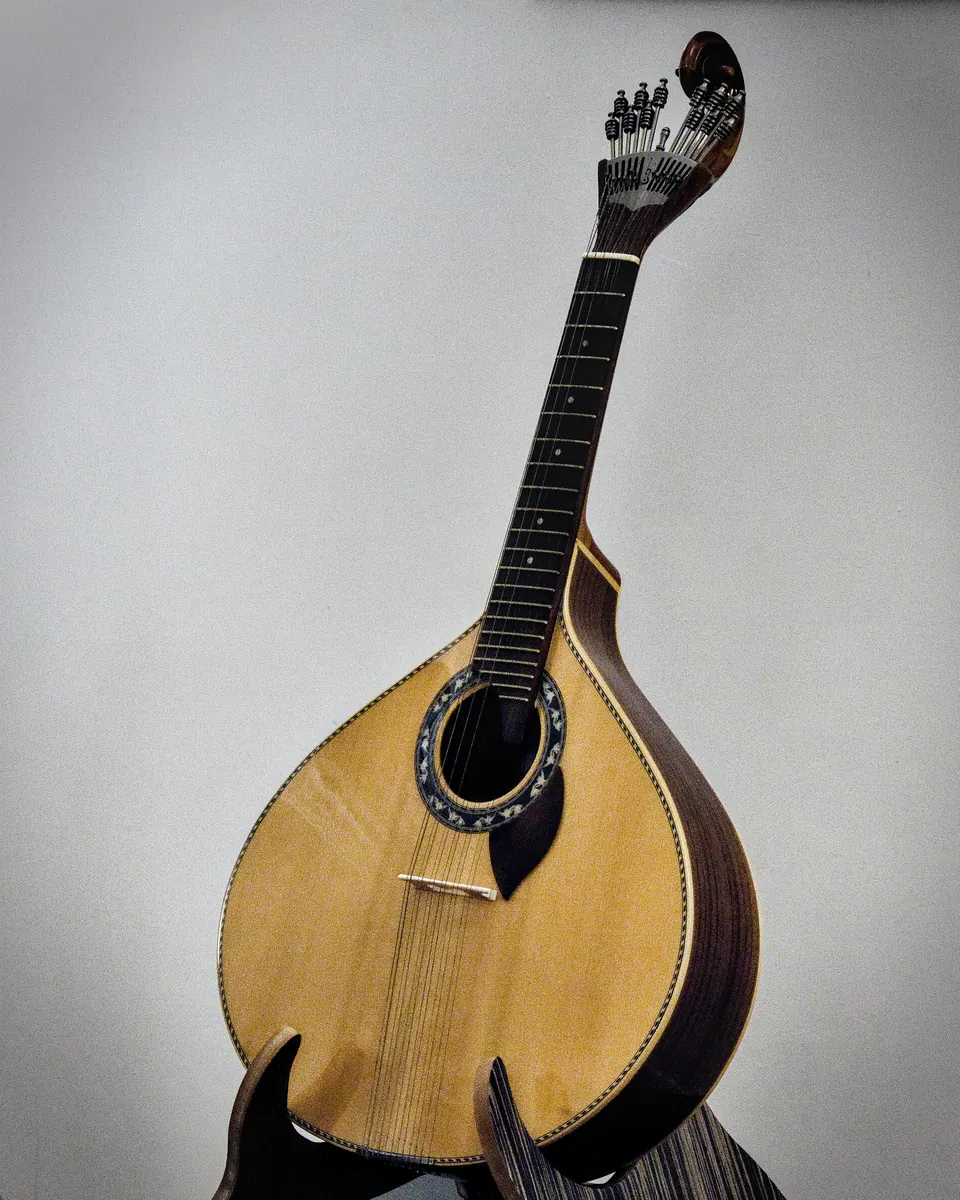
Twelve steel strings sit on the instrument in six courses of two, so each note is sounded by a pair of strings tuned together. The body is pear-shaped, and the instrument has its own tuning and its own place in Portuguese music, above all in fado. In a concert it is the instrument you will hear most clearly beside the singer's voice.
Where it comes from
The medieval citole is its distant ancestor, and traces of its use in Portugal date from the thirteenth century. Citterns were popular in Europe from the sixteenth to the eighteenth centuries, and a sculpture of about 1680 at Alcobaça Monastery shows a direct ancestor. The English guitar, a type of cittern, arrived around 1750, and its influence survives in the watch-key tuning, the size, the six-course stringing and the natural tuning. Portuguese luthiers later widened the body, lengthened the scale and widened the fingerboard, which gave the instrument its present shape.
The fan and the watch key
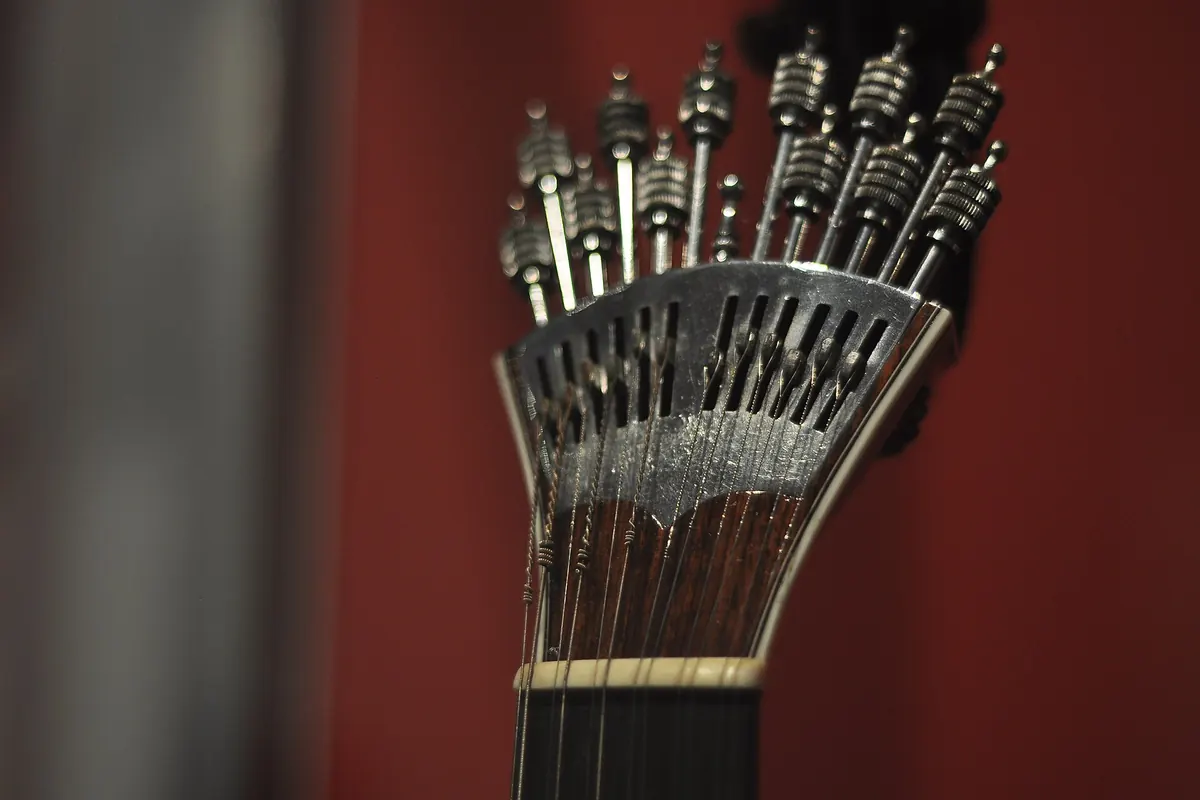
The most distinctive part of a Portuguese guitar is at the head: a fan-shaped metal plate carrying the tuning keys. It is one of the few instruments that still use watch-key tuners, also called Preston tuners, turned with a small key. The fan also decorates the instrument, and the motif at the head differs by city. A Lisbon guitar usually has a scroll, called a caracol, and a Coimbra guitar a teardrop, called a lágrima.
Lisbon and Coimbra guitars
Two models are played. The Lisbon guitar is tuned a tone higher, to D, and has a scale length of 445 millimetres, a broader soundboard and a shorter, narrower neck. The Coimbra guitar is tuned to C and has a scale length of 470 millimetres and simpler construction, giving a darker sound. Coimbra players still use Lisbon note names, so their C is called a D. The difference is also one of tradition: Coimbra fado grew around the university, and Lisbon fado in the old working-class quarters.
What it does in a fado
In Lisbon-style fado the Portuguese guitar plays the introduction, then answers the singer in call and response, and improvises in the faster songs. Fado accompaniment also uses the viola de fado, a steel-strung classical guitar, and sometimes a double bass. In Coimbra fado the guitar plays chordal accompaniment alongside an acoustic guitar. If you listen for one thing during a concert, listen for the small phrases the guitar plays in the gaps after each line the singer finishes.
Players worth hearing
Several guitarists are named in the sources as notable players of the instrument. They include Armandinho, born in 1891, and Artur Paredes, born in 1899, who revolutionised the tuning and style of the Coimbra guitar. His son Carlos Paredes is also on the list, with Fontes Rocha and António Chainho. Marta Pereira da Costa is described as the first female virtuoso of the instrument. Listening to a recording of any of them before a concert gives your ear a template for the answering phrases you will hear live.
Makers and where to hear one
Two families of Portuguese makers are named in the sources: the Cardoso workshop, now in Ericeira, and the Grácio family, whose last direct representative, Gilberto Grácio, lived from 1936 to 2021. Casa da Guitarra in Porto adds a Porto address, as a shop, a permanent exhibition and a concert room. The venue says the guitar played in its concert was handcrafted by a Porto luthier, so the instrument and the song share a room. That is the case for hearing fado there. The Fado Museum's workshop in Lisbon honours both schools.
Read next: Casa da Guitarra: how to book
Frequently asked questions
How many strings does a Portuguese guitar have?
Twelve steel strings, in six courses of two. Each pair is tuned together.
Is a Portuguese guitar the same as a classical guitar?
No. It is pear-shaped, steel-strung and tuned with watch keys. Fado also uses a viola, a steel-strung classical guitar, for the rhythm.
Sources